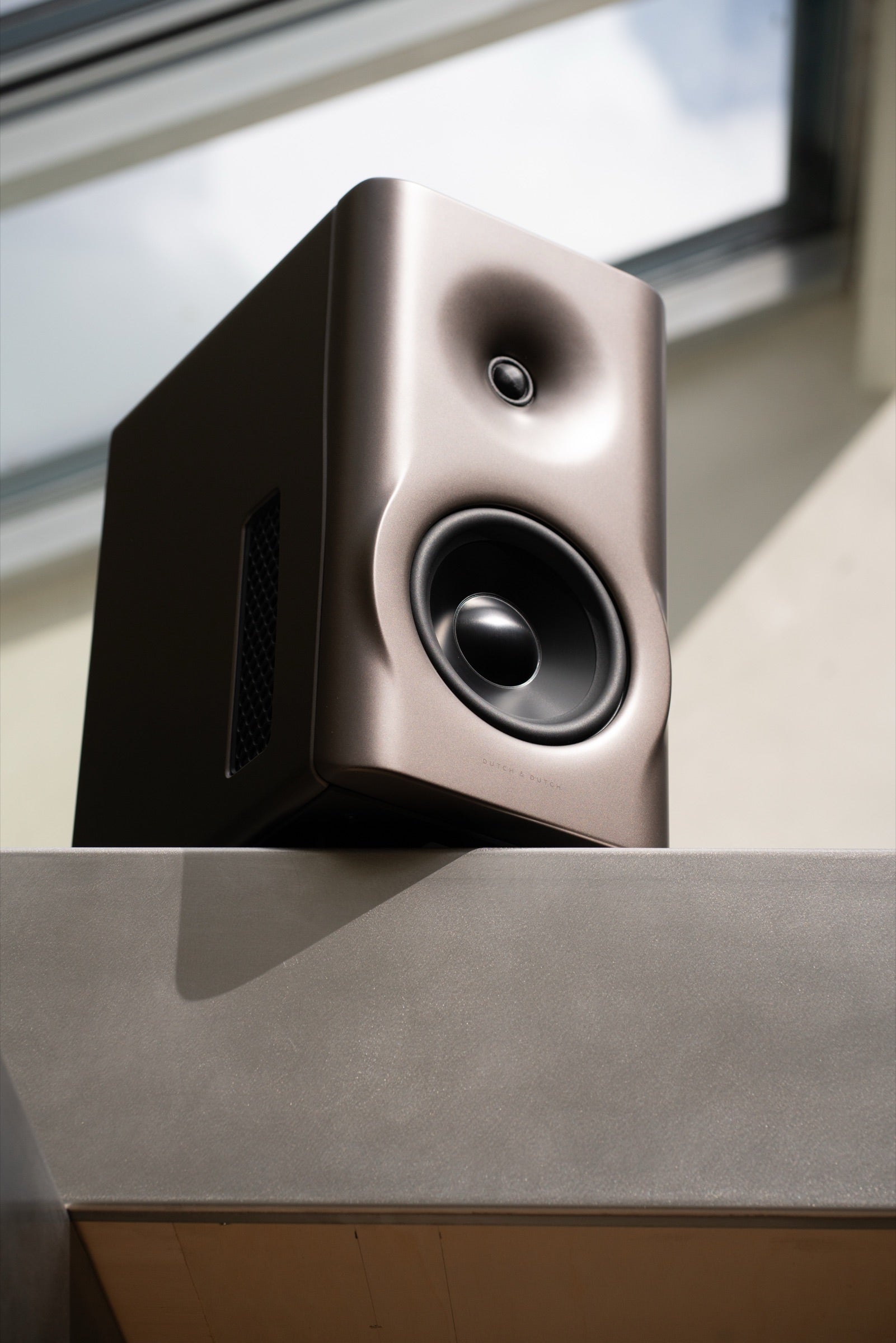
Why great speakers can sound wrong at home
You don’t just hear the speaker. You hear the room.
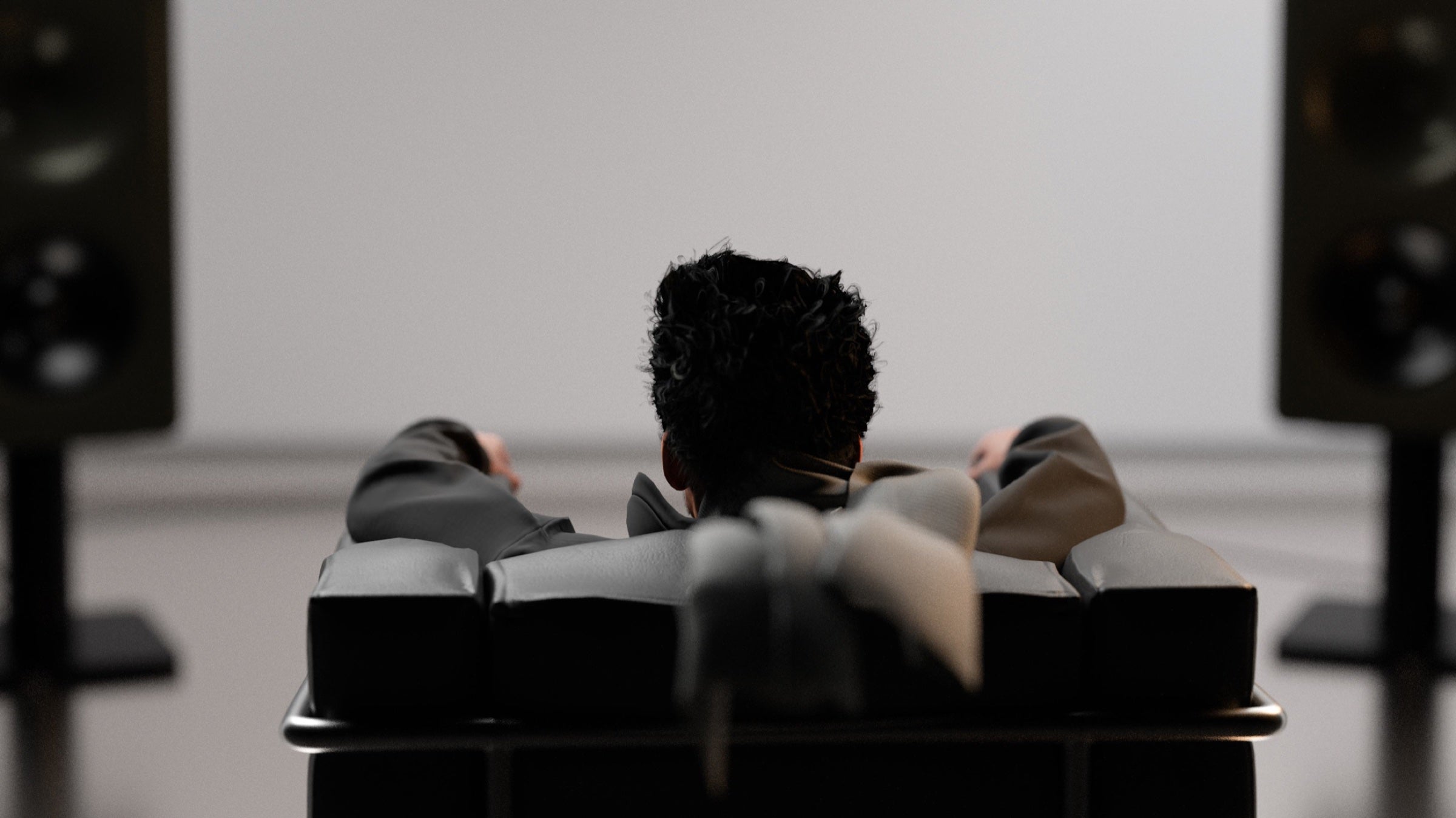
The loudspeaker, its placement and the room. As one system
RoomMatching is Dutch & Dutch’s unique, first-principles, holistic approach to loudspeaker-room integration.
-
Acoustic design
Controls how sound enters the room.
-
Align
Calibrates the system to the specific space.
-
Personal Tuning
Lets you refine the final RoomMatching profile by ear and make it yours.
The result is true reference sound without turning your living room into a recording studio.
Traditional hi-fi optimises only half the listening system
Traditional hi-fi concentrates on the signal chain:
source → electronics → loudspeaker

But the complete listening system continues:
source → electronics → loudspeaker → room → listener

The loudspeaker is the end of the signal chain and the beginning of the acoustic chain. Traditional hi-fi optimises the first half. RoomMatching also controls the second. Dutch & Dutch brings both together as one complete system.
One room, two acoustic personalities
A normal listening room behaves differently at different frequencies.
-

In the bass: a resonant instrument
The room’s dimensions reinforce some bass notes and weaken or cancel others. The result is uneven bass. Some notes sound too loud and boomy, while others lose weight or seem to disappear.
-

Higher up: a hall of mirrors
Sound reflects from the walls, floor, ceiling, furniture and other surfaces. These reflections combine with the direct sound. Their level, timing, direction and tonal character influence clarity, imaging and tonal balance.


Below the room’s transition region, resonances and boundary effects dominate. Above it, the relationship between direct and reflected sound becomes increasingly important.
This is why no single technique can solve the complete speaker-room interaction. RoomMatching uses different forms of acoustic and digital control where each is most effective.
A good speaker can still sound wrong in an ordinary room
A good conventional loudspeaker can measure smooth and balanced directly in front of it. Put it in a normal living room and the result can change dramatically.
-

The room introduces:
Bass peaks and dips
Boundary reinforcement and cancellation
Strong early reflections
Reflected sound that reshapes the tonal balance
-
The results may sound familiar:
Vocals that do not lock into place
Bass that sounds uneven or boomy
Detail that disappears at normal listening levels
Midrange that sounds forward or shouty
Treble that becomes tiring

The problem is not necessarily that the loudspeaker is bad. It’s that the loudspeaker and room were not designed to behave as one system.
Why changing components cannot solve the whole system
-

-
When a system disappoints, the familiar response is to change the amplifier, streamer, cables or loudspeakers. Those changes can matter, but they often leave the acoustic path between the loudspeaker and listener largely uncontrolled.
Acoustic treatment can be highly effective, but studio-like control usually demands more treatment, space and visual compromise than most living rooms allow. The loudspeaker still needs to interact predictably with the room.

RoomMatching controls how sound enters the room
Control the physics first. Refine digitally second.
It treats the loudspeaker, its placement, nearby boundaries and the room as parts of one acoustic system. Three technologies work together across the frequency range.
-

Boundary-Coupled Bass
Uses the nearby wall as part of the acoustic design, turning practical placement into more predictable, smoother and more extended low-frequency performance.
-

Natural Cardioid Midrange
Directs more midrange energy toward the listening area and less toward nearby side and rear walls, reducing the strongest early reflections. Its controlled vertical radiation also reduces energy directed toward the ceiling.
-

Minimum-Diffraction Waveguide
Minimises diffraction and controls high-frequency dispersion. Its directivity is smoothly matched to the Natural Cardioid Midrange, so sound leaving the loudspeaker at an angle remains closer in tonal character to the direct sound.


Together, these technologies create:
Smoother, more extended bass
Controlled boundary interaction
A balanced direct response
Fewer strong early reflections
More consistent reflected sound
The room is no longer simply an unpredictable influence, it becomes a predictable part of the system.

RoomMatching Align matches the system to your room
Align is the guided room-calibration system in the Dutch & Dutch app. Using a calibrated measurement microphone connected to your phone, it guides you through measurements around the listening area, then calculates the required filters and applies them directly to the loudspeakers’ DSP. Acoustic design establishes predictable behaviour; Align completes the match.
- Guided calibration experience that optimizes your loudspeakers for your room, step by step.
- Filters applied directly to the loudspeaker over the air
- Correction focused where it’s most effective — especially in the bass
Personal Tuning makes it yours
Align automatically calculates the correction required for the room and listening area. Personal Tuning lets you refine the final RoomMatching profile by ear.
-
You might use Personal Tuning to:
Add subtle warmth
Create a preferred house curve
Apply a gentle tonal tilt
Refine a particular frequency region
Shape the presentation around your listening preferences
-
Using the additional EQ available within RoomMatching, you can make deliberate adjustments while retaining the controlled acoustic and calibrated foundation underneath.
Personal Tuning is intended for considered, persistent changes to the RoomMatching profile. For immediate adjustments based on taste, mood, listening level or a particular recording, Voicing remains separately available from the app’s home screen.
Acoustic design establishes the system. Align matches it. Personal Tuning makes it yours.
What you hear at home
A normally furnished living room can remain a living room. Rugs, curtains, upholstery, bookshelves and furniture can all help — but the loudspeaker provides the fundamental acoustic control.
What changes is what you hear:
Clearer voices
More stable imaging
More even, extended bass
Smoother and less tiring sound
More consistent performance across the listening area
Greater confidence that you are hearing the recording rather than fighting the room
RoomMatching transforms the room from an unmanaged variable into an integrated part of the system design. The complete listening chain works together:
source → electronics → loudspeaker → room → listener
Reference sound in real rooms.
HEAR IT IN YOUR ROOM
Find a dealer near you to experience full-range RoomMatching first hand.